
Freeborn County Court Record Requests
Work the channels in order. Do not assume a remote screen shows the whole file. Begin with Minnesota Court Records Online, known as MCRO. Use it to pull the case number, the Register of Actions, and any eligible documents. When the exact case number is already in hand, Document Search is the faster tool. An eligible record that is not online can still be reached at a Minnesota courthouse public-access terminal. It can also be reached at Freeborn Court Administration, or by calling the local office. Certified records and unavailable papers come through the copy-request process.
The statewide Copy Request Form can go by mail, in person, or through eFS where that applies. Send the completed form and payment to Court Administration. It goes in the county where the case was filed. The Court Administration counter, not a city clerk or county archive, is the route to a Freeborn District Court file. Public-data rules set the baseline under Minn. Stat. §13.03. Judicial Branch fees and court rules control the copy service itself.
- Find the Freeborn case number through MCRO Case Search or Document Search when possible.
- Note the party names, document description, date, and index number shown in the Register of Actions.
- Download an available plain electronic document from MCRO if that copy meets the need.
- For a certified, exemplified, paper, older, or unavailable document, complete the statewide Copy Request Form and select the delivery option.
- Send the request and any current fee to Freeborn Court Administration, then use CON100 only when confidential or sealed access is the issue.
Freeborn County Records Counter
Minnesota runs a unified District Court model. There is no separate criminal, civil, or municipal clerk portal in Freeborn County. Instead, Freeborn Court Administration keeps the local trial-court record inside the Minnesota Judicial Branch system. That structure has a practical effect. A city ordinance matter, a traffic ticket, and a civil suit filed in Freeborn all land in the same District Court. The same Court Administration office serves them.
Freeborn Court Administration
Freeborn County Government Center
411 South Broadway
Albert Lea, MN 56007
Public business hours: Monday through Friday, 8:00 a.m. to 4:30 p.m.
The official Freeborn court page gives the local address, phone route, and court information. Inside the courthouse, the public terminal opens statewide case records, and for eligible material it can show more than remote access does. Ask Court Administration where the terminal or counter sits. Floor and terminal numbers change.
Kinds of Court Records
A Register of Actions is a chronological index of every event in a case. Behind it sit the filed papers. Those include a complaint, a motion, an affidavit, an order, a judgment, an exhibit, or other issued items. Any one document may be public, confidential, sealed, or beyond remote coverage. A case appearing in MCRO does not mean its whole file is available online.
A transcript is not an ordinary copy. The court reporter prepares it from the hearing, and requests go to that reporter. Birth, death, marriage, real-estate, immigration, and city administrative records sit elsewhere. They are outside Court Administration's copy route entirely. Match each record type to the office that actually keeps it. Otherwise the request goes to the wrong desk.
Freeborn County Copy Request Form
Freeborn has no county-specific form. The statewide form is the route. It opens with the basics: name, date, address, phone, city, state, ZIP, and email. Next comes the case type and the court file number. If that number is unknown, give the county plus as much identifying detail as possible. Case-type choices cover Civil, Family, Criminal, Conciliation, Juvenile, and Probate, Guardianship, Conservatorship, or Mental Health.
The document table starts with four rows. Each row wants the document name or description. It also wants its date or index number, the copy type, the number of copies, and the cost. Plaintiff or petitioner and defendant or respondent details follow, along with an Other parties field. A criminal request also needs the defendant's date of birth. Attach extra sheets if four rows are not enough.
The Minnesota Copy Request Forms page shows the statewide form. It is the form used for Freeborn County court case records.
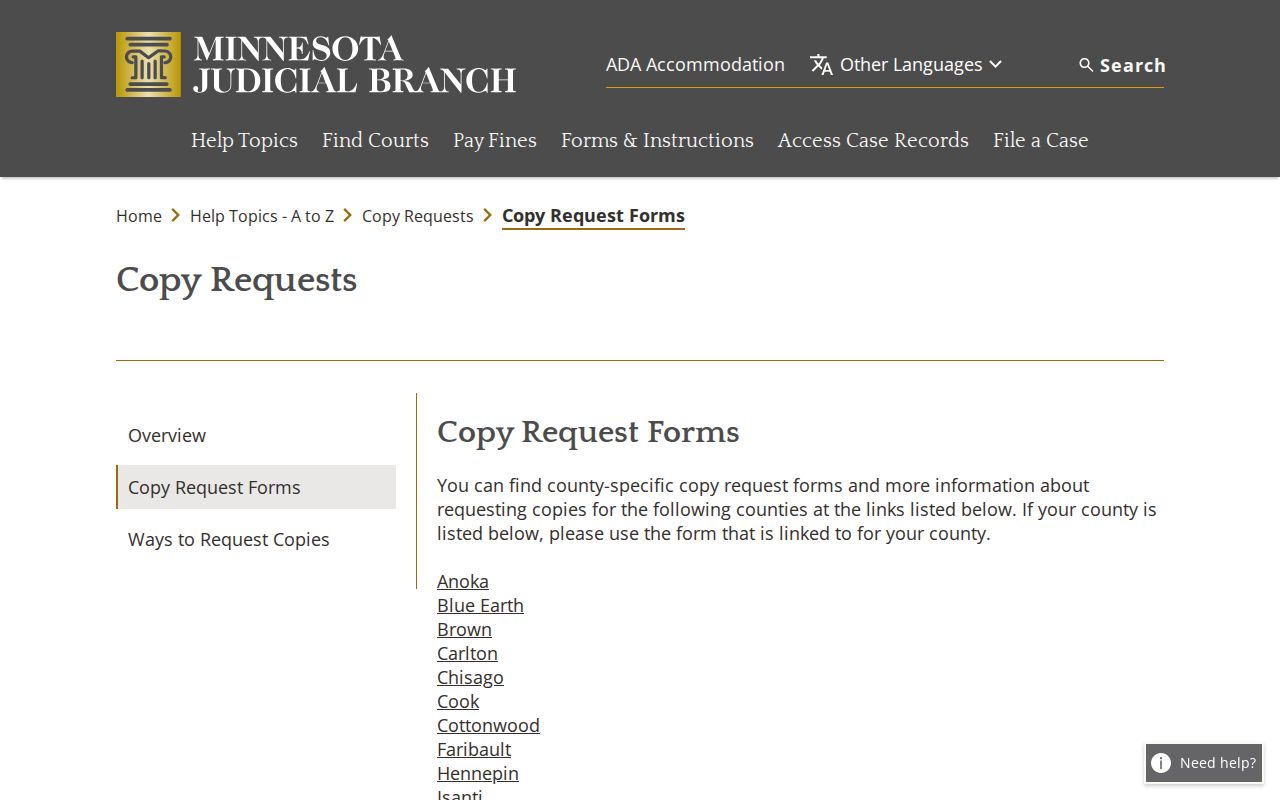
Exact document details let Court Administration match the request to the right case file and copy type.
Court Records: What They Contain
In MCRO, the case details hold the file together. One case number ties the parties, the category, the chronological Register of Actions, hearings, public filings, orders, judgments, and any financial or satisfaction data the portal provides. The daily calendar is only a schedule view. It cannot replace the full event history.
| Case identity | Case number, court location, category, and party information used to identify the file. |
|---|---|
| Register of Actions | The chronological event history, including filings and settings entered in the case. |
| Documents | Eligible public complaints, motions, orders, judgments, or other filings, subject to access limits. |
| Hearings | Scheduled dates and setting information, which should be checked against the hearing notice. |
| Judgment information | Public judgment or satisfaction information where it is available in the court record. |
| Access classification | Public, confidential, sealed, or otherwise restricted treatment under rule, law, or order. |
Treat these fields as parts of one record. A case title or a single docket event is not a final conclusion. The court holds the current record, even though the portal makes selected information easy to find.
Freeborn County Copy Delivery Choices
The statewide request form gives you choices for getting copies back. United States Mail, counter pickup, fax, email, and prepaid courier such as FedEx or UPS all appear as options. Courier delivery needs a prepaid label. Fax and email work only for plain, non-confidential material. If you want copies by mail, include a mailing address. Walk-in requests are usually finished the same day. A file stored offsite can slow things down. Freeborn County publishes no set mail turnaround, so plan for some wait.
Make checks or money orders payable to District Court Administrator. Do this unless current Court Administration instructions direct otherwise. Never choose email or fax for a certified or confidential record. Sending the form through eFS only requests a copy. It cannot change the case record itself. A nonparty filing through eFS should ask Court Administration for an administrative file number. That requirement sits under the statewide guidance.
Copy Fees and Certification
Freeborn County's district-court fee schedule splits copies into types. A plain, uncertified copy shows a price of $0. So does a printout, scan, or screen print. A certified copy carries a raised seal. An exemplified copy lists the signatures on the form, and a combined certified and exemplified copy includes the seal plus both signatures. Ask for the exact type you need, and handle certified pages with care. Pull the staple on a multi-page certified document and it stops being certified.
| Copy type | Freeborn fee | What the schedule or form identifies |
|---|---|---|
| Plain or uncertified copy | $0 | Free printout, scan, screen print, or other plain copy. |
| Certified copy | $14 | Certified copy of a civil or criminal instrument, per document. |
| Exemplified and uncertified copy | $14 | Exemplified type listed on the Freeborn schedule. |
| Certified and exemplified copy | $28 | Raised seal with signatures of the judicial officer and court administrator. |
Check the Freeborn District Court fees page for the current category and authorization. Filing fees, fax fees, and other services sit on separate schedule lines. They are not substitutes for copy fees.
Freeborn County eFS Filing Distinction
Minnesota eFile and eServe, known as eFS, is the courts' electronic filing and service system. Attorneys, government agencies, and guardians ad litem must use it. It covers filings in all 87 counties. Self-represented filers may opt in voluntarily. eFS and MCRO do different jobs. eFS moves filings and service through the court system. MCRO shows eligible public information and documents.
Every electronic document carries a security classification: public, confidential, or sealed. That makes the filing code and security level important choices. Criminal complaints, citations, tab charges, and juvenile delinquency petitions or citations are not filed through eFS. Later covered documents are filed differently. When e-filing is not required, paper filing or mailing to the courthouse may still be an option. The Minnesota eFile and eServe page draws the line. It separates Freeborn County court filing from public record access.
Filing through eFS does not promise public availability. Document security classification and Rule 8 access categories still control what anyone can view.
Freeborn County Older Court Documents
MCRO's main online document window covers filings made on or after July 1, 2015. Coverage before that date is spotty. When a public document is not linked in MCRO, write down the case number first. Then try a courthouse MNPAC public terminal, the State Law Library, or Freeborn Court Administration. A document can be missing from remote access. That does not mean it is missing from the court file. The Minnesota law libraries resource offers a statewide fallback for court-record access.
Older records may still need a court or library channel even after the case turns up online.
Access Rules for Court Records
Minnesota Rule of Public Access 8 sets the rules for inspection and copying. It also governs remote access and Register of Actions access. Some categories stay off remote display. That is why courthouse access can be more complete than MCRO. Sensitive details stay protected. Minn. Stat. §13.03 presumes government data is public unless law classifies it otherwise. Inspection is free. Copying may carry reasonable costs, with court-specific fees governed by the Judicial Branch schedule.
Rule 11 shields identifiers in filings. These include Social Security numbers, employer identification numbers, and financial-account numbers. Juvenile, sealed, confidential, and some family or commitment records face added limits. For confidential or sealed material, use the CON100 request form when it applies. The form asks for the county, judicial district, and case information. It also requests the records sought, your involvement, detailed reasons, a signature, and contact information. There is no filing fee. A judicial officer decides the request.
Access limit: A standard copy request does not override a seal or confidentiality rule. For a public record not online, ask about terminal access or a copy. For a sealed or confidential record, follow the form and wait for the judicial decision.
Adoption records run on their own set of forms. A named party in a confidential but unsealed case can instead get records by verifying identity with Court Administration.
Freeborn County Filing Security Levels
The eFS resource material lays out filing codes and document security levels. The distinction matters. A filed item may never show up remotely. A document can be a genuine court filing yet still be marked confidential or sealed. Or it can fall into a record category with restricted remote access. When you need a copy, describe the document precisely. Then ask the court whether it is publicly viewable at the terminal. Or ask whether it is available through a request. The eFS resources page connects security classifications to Freeborn County court case records.
A security label is an access control, not proof the matter does not exist.